How to type Per Ten Thousand
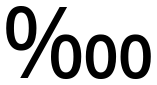
To type Per Ten Thousand (‱), press Alt + 8241 on Windows, holding Alt while typing the digits on the numeric keypad, or write ‱ in HTML. On any system you can copy it from this page, or enter its codepoint U+2031 directly: Ctrl+Shift+U then 2031 on Linux, or 2031 then Alt+X in Microsoft Word.
Per Ten Thousand Sign
- Copy it
- Unicode
- U+2031
- Windows
- Alt + 8241 needs regedit
| Where | Shortcut | How |
|---|---|---|
| Windows | Alt + 8241 | Above 255, so Windows will not accept it as typed. Copy the character instead. |
| Mac | N/A | Press the keys together. |
| HTML | ‱ | Paste this into HTML source. |
| Unicode | U+2031 | PER TEN THOUSAND SIGN |
Other math symbols
‱ lives in the General Punctuation block (U+2000-U+206F), dashes, quotation marks, spaces and reference marks used across languages. Within Unicode it is classified as Po, a punctuation mark. Its bidirectional class makes it a European number terminator, so it sits beside a number without breaking its direction.
What Unicode says about Per Ten Thousand
The standard recognises ‱ under another name as well: permyriad. That is a formal alias, not a nickname, which is why it turns up in other people's documentation for the same codepoint.
Unicode annotates ‱ directly. Against U+2031 the code chart carries the note “Percent of a percent, rarely used”. That is the standard saying what the character is for, rather than an inference from its name.
The code chart points from ‱ to Percent Sign and arabic-indic per ten thousand sign (U+060A). These are the characters the standard thinks you might have meant instead, which makes them the ones worth checking when Per Ten Thousand looks nearly right but not quite.
How Per Ten Thousand behaves in software
‱ takes one column in a terminal. It carries no direction of its own, so in a line that mixes English with Arabic or Hebrew it takes the direction of the text around it rather than forcing one.
Every way to write Per Ten Thousand
| Form | Value |
|---|---|
| Codepoint | U+2031 |
| Decimal | 8241 |
| UTF-8 bytes | E2 80 B1 |
| UTF-16 bytes | 20 31 |
| HTML entity | ‱ |
| HTML numeric | ‱ or ‱ |
| CSS | \2031 |
| JavaScript | \u2031 |
| Python | \u2031 |
| URL-encoded | %E2%80%B1 |
| SVG | 2031.svg · (SIL Open Font License) |
If ‱ arrives as ‱
Its three UTF-8 bytes E2 80 B1 are being read one at a time as Windows-1252. The text is undamaged; the reader has to be told it is UTF-8.