How to type Psi
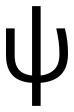
To type Psi (ψ), press Alt + 968 on Windows, holding Alt while typing the digits on the numeric keypad, or write ψ in HTML. On any system you can copy it from this page, or enter its codepoint U+03C8 directly: Ctrl+Shift+U then 03c8 on Linux, or 03c8 then Alt+X in Microsoft Word.
Greek Small Letter Psi
- Copy it
- Unicode
- U+03C8
- Windows
- Alt + 968 needs regedit
| Where | Shortcut | How |
|---|---|---|
| Windows | Alt + 968 | Above 255, so Windows will not accept it as typed. Copy the character instead. |
| Mac | N/A | Press the keys together. |
| HTML | ψ | Paste this into HTML source. |
| Unicode | U+03C8 | GREEK SMALL LETTER PSI |
Other greek symbols
ψ lives in the Greek and Coptic block (U+0370-U+03FF), the Greek alphabet, used throughout mathematics and the sciences. Within Unicode it is classified as Ll, a lowercase letter. It has an uppercase counterpart and changes under case conversion. Its bidirectional class makes it left-to-right.
Its uppercase counterpart is Ψ (U+03A8). They are separate codepoints, so a byte comparison treats them as different characters even though a case-insensitive search does not.
What Psi is used for
In mathematical notation ψ is a variable: it stands for a quantity rather than acting on one, so an equation treats it the way it treats x, and the spacing around it is the spacing around a letter. That is the classification unicode-math gives it, and it is what decides how the symbol is set: $\muppsi$ in LaTeX, in maths mode rather than in a sentence.
The command is \muppsi rather than the \psi most people reach for, and the difference is not cosmetic: mup is unicode-math for maths, upright, and this codepoint is the upright letter. Plain LaTeX's short command gives the sloped math-italic letter, which is a different character with a different codepoint. Copying ψ into an equation gets you the upright one.
ψ is a letter before it is a symbol, and on the Greek keyboard layout it is simply C: the key your keycap already calls C. That is the route when you are typing Greek rather than reaching for one character. How to type Greek on a keyboard has the whole map.
How Psi behaves in software
ψ is East Asian Ambiguous: one column in a Western locale and two in a CJK one. That is why a table that lines up on your machine can break on somebody else's, with no change to the text at all. It is a left-to-right character, so it holds that direction even inside a right-to-left paragraph.
Every way to write Psi
| Form | Value |
|---|---|
| Codepoint | U+03C8 |
| Decimal | 968 |
| UTF-8 bytes | CF 88 |
| UTF-16 bytes | 03 C8 |
| HTML entity | ψ |
| HTML numeric | ψ or ψ |
| CSS | \03C8 |
| JavaScript | \u03C8 |
| Python | \u03C8 |
| URL-encoded | %CF%88 |
| LaTeX, in maths mode | $\muppsi$ |
| SVG | 03C8.svg · (SIL Open Font License) |
If ψ arrives as ψ
That is this exact character, undamaged: its two UTF-8 bytes CF 88 are being read one at a time as Windows-1252. The Latin-1 range is where this happens most, because it is the range every legacy system thought it already handled. Nothing is lost, and retyping will not help: the fix is at the reading end, which has to be told the text is UTF-8. An empty rectangle is the opposite complaint, and means the encoding is right and the font has no glyph for U+03C8.