How to type There Does Not Exist
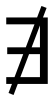
To type There Does Not Exist (∄), press Alt + 8708 on Windows, holding Alt while typing the digits on the numeric keypad, or write ∄ in HTML. On any system you can copy it from this page, or enter its codepoint U+2204 directly: Ctrl+Shift+U then 2204 on Linux, or 2204 then Alt+X in Microsoft Word.
There Does Not Exist
- Copy it
- Unicode
- U+2204
- Windows
- Alt + 8708 needs regedit
| Where | Shortcut | How |
|---|---|---|
| Windows | Alt + 8708 | Above 255, so Windows will not accept it as typed. Copy the character instead. |
| Mac | N/A | Press the keys together. |
| HTML | ∄ | Paste this into HTML source. |
| Unicode | U+2204 | THERE DOES NOT EXIST |
Other math symbols
∄ lives in the Mathematical Operators block (U+2200-U+22FF), the core set of mathematical and logical operators. Within Unicode it is classified as Sm, a mathematical symbol. Software may lay it out with the spacing an operator expects.
∄ has a decomposed form: it can also be written as U+2203 There Exists, U+0338 Combining Long Solidus Overlay. The two look identical and are not equal as strings, which is why a search for a word containing ∄ sometimes fails against text that was typed on a different system. Everything on this site uses the single-codepoint (NFC) form shown here.
What There Does Not Exist is used for
In mathematical notation ∄ is an ordinary symbol: it carries no special spacing and sits in an expression the way a letter does, standing for a thing rather than doing something to the things around it. That is the classification unicode-math gives it, and it is what decides how the symbol is set: $\nexists$ in LaTeX, in maths mode rather than in a sentence.
How There Does Not Exist behaves in software
∄ takes one column in a terminal. It carries no direction of its own, so in a line that mixes English with Arabic or Hebrew it takes the direction of the text around it rather than forcing one. It is a mirrored character: in right-to-left text it is drawn reversed, so it keeps pointing at what it pointed at.
Every way to write There Does Not Exist
| Form | Value |
|---|---|
| Codepoint | U+2204 |
| Decimal | 8708 |
| UTF-8 bytes | E2 88 84 |
| UTF-16 bytes | 22 04 |
| HTML entity | ∄ |
| HTML numeric | ∄ or ∄ |
| CSS | \2204 |
| JavaScript | \u2204 |
| Python | \u2204 |
| URL-encoded | %E2%88%84 |
| LaTeX, in maths mode | $\nexists$ |
| SVG | 2204.svg · (SIL Open Font License) |
If ∄ arrives as ∄
One character has become three, which is what a three-byte UTF-8 sequence looks like when each byte is read separately: E2 88 84 read as Windows-1252 gives exactly ∄. The text is intact and the damage is in the reading, so setting the reader to UTF-8 restores it and retyping does not. A rectangle instead of the mojibake means the opposite: the encoding is right and the font has no glyph at U+2204, which for a character this far outside Latin-1 is common in older office fonts.