How to type Female Sign
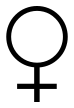
To type Female Sign (♀), press Alt + 12 on Windows, holding Alt while typing the digits on the numeric keypad, or write ♀ in HTML. On any system you can copy it from this page, or enter its codepoint U+2640 directly: Ctrl+Shift+U then 2640 on Linux, or 2640 then Alt+X in Microsoft Word.
Female Sign
- Copy it
- Unicode
- U+2640
- Windows
- Alt + 12
| Where | Shortcut | How |
|---|---|---|
| Windows | Alt + 12 | Hold Alt and type the number on the numeric keypad. |
| Mac | N/A | Press the keys together. |
| HTML | ♀ | Paste this into HTML source. |
| Unicode | U+2640 | FEMALE SIGN |
Other symbols
♀ lives in the Miscellaneous Symbols block (U+2600-U+26FF), weather, astrology, religion, games and a wide miscellany. Within Unicode it is classified as So, a symbol.
How to type ♀ in Microsoft Word
In Microsoft Word, type 2640 and press Alt + X. Word reads the four characters before the cursor as a hex codepoint and replaces them, and pressing Alt + X again turns ♀ back into 2640, which is the quickest way to check what a character really is.
What Female Sign is used for
In mathematical notation ♀ is an ordinary symbol: it carries no special spacing and sits in an expression the way a letter does, standing for a thing rather than doing something to the things around it. That is the classification unicode-math gives it, and it is what decides how the symbol is set: $\female$ in LaTeX, in maths mode rather than in a sentence.
Unicode publishes a second list of names for ♀ in CLDR, the keywords its own search data offers rather than the formal name, and it is woman. That word is what somebody looking for this character is liable to type when Female Sign is not the name they know it by, and the search on the symbol lists matches it as well as the Unicode name.
What Unicode says about Female Sign
The standard recognises ♀ under other names as well: Venus, alchemical symbol for copper. Those are a formal alias, not a nickname, which is why they turn up in other people's documentation for the same codepoint.
The code chart points from ♀ to woman (U+1F469) and womens symbol (U+1F6BA). These are the characters the standard thinks you might have meant instead, which makes them the ones worth checking when Female Sign looks nearly right but not quite.
How Female Sign behaves in software
♀ is East Asian Ambiguous: one column in a Western locale and two in a CJK one. That is why a table that lines up on your machine can break on somebody else's, with no change to the text at all. It carries no direction of its own, so in a line that mixes English with Arabic or Hebrew it takes the direction of the text around it rather than forcing one.
What people ask about Female Sign
What's the sign for male and female?
♀ is FEMALE SIGN, encoded at U+2640. It is distinct from woman (U+1F469) and womens symbol (U+1F6BA), which the chart lists beside it precisely because they are confused for one another.
How to insert male and female symbols in word?
In Word, type 2640 and press Alt+X, which converts the codepoint you just typed into ♀. Insert › Symbol › More Symbols finds it by its Unicode name, FEMALE SIGN. Google Docs has no Alt+X, so use Alt + 12 there, or Insert › Special characters and search the same name.
Every way to write Female Sign
| Form | Value |
|---|---|
| Codepoint | U+2640 |
| Decimal | 9792 |
| UTF-8 bytes | E2 99 80 |
| UTF-16 bytes | 26 40 |
| HTML entity | ♀ |
| HTML numeric | ♀ or ♀ |
| CSS | \2640 |
| JavaScript | \u2640 |
| Python | \u2640 |
| URL-encoded | %E2%99%80 |
| LaTeX, in maths mode | $\female$ |
| SVG | 2640.svg · (SIL Open Font License) |
If ♀ arrives as ♀
One character has become three, which is what a three-byte UTF-8 sequence looks like when each byte is read separately: E2 99 80 read as Windows-1252 gives exactly ♀. The text is intact and the damage is in the reading, so setting the reader to UTF-8 restores it and retyping does not. A rectangle instead of the mojibake means the opposite: the encoding is right and the font has no glyph at U+2640, which for a character this far outside Latin-1 is common in older office fonts.